Let’s debunk an assumption floating in the air: AI stands as the great savior of modern education. True, it can streamline administrative tasks and provide rich data-driven insights. Yet beneath the surface, its indiscriminate use could be eroding the pillars of authentic learning.
This isn’t about shunning technology, far from it. It’s about observing it through a discerning eye, taking into account a perspective that is often overshadowed by the allure of next-gen wizardry. Now, we are going to delve into the crux of the matter, that is, the risks and reservations tied to AI’s integration into the learning sphere.
The Cost of Convenience: AI and the Dilution of Effort
Picture an average student enmeshed in a complicated assignment. Before the advent of AI-powered tools, the student would grapple with it, dedicating considerable effort and brainspace to truly understand complex notions. However, with AI now offering shortcuts, the student receives answers without experiencing the struggle, a pitfall marking why AI should not be used in education.
This scenario has troubling implications. By skipping the cognitive odyssey, students merely consume information without fully comprehending it, akin to a shallow rippling stream rather than a profound, flowing river of understanding. This devalues creative problem-solving, as AI’s reliance on fixed calculations and probabilities lacks the beautiful irregularities of human creativity.
Moreover, this diminishes the skill of knowledge retention. Students are gifted with convenient answers, causing a stark decrease in their ability to remember and synthesize knowledge autonomously. They simply become passive data recipients, making the journey of learning less of a fulfilling quest for knowledge and more a fast-food consumption of facts.
Circling back to the hypothetical student, she uses AI to complete her assignment, a veneered perfection masking a lack of deep understanding. The true intellectual effort resides behind the shiny AI window, an unseen casualty of this technological convenience.
Slipping Skills: When AI Interferes with Learning
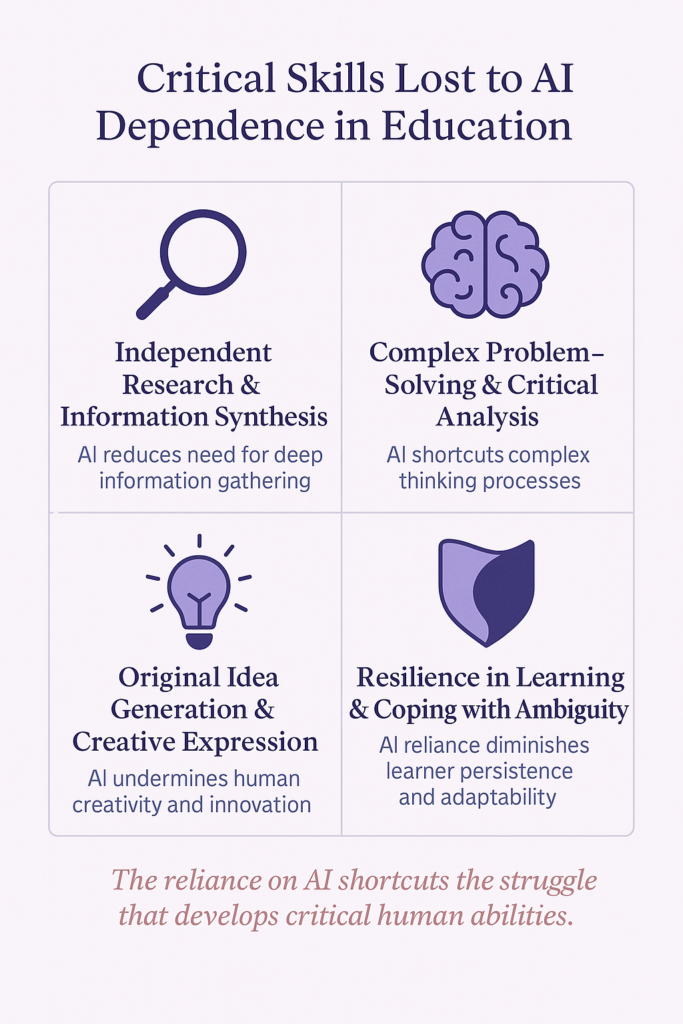
- Independent Research & Information Synthesis: Unearthing relevant information and stitching the fragments into a coherent whole is an art learned through practice. AI, with quick fixes and ready-made answers, inhibits this crucial learning exercise. No pains are taken to sift through resources, evaluate their credibility, and construct meaning.
- Complex Problem-Solving & Critical Analysis: When AI platforms spit out solutions, students sidestep the in-depth analysis and critical thinking. Waiting for algorithms to break down complexities can slow the development of these vital analytical skills.
- Original Idea Generation & Creative Expression: The beauty of the human mind lies in its capability to create, to generate ideas from nothingness. Annihilating this spark are AI tools, dishing out suggestions based on pre-set codes and formulations, hampering the cultivation of creative thinking.
- Resilience in Learning & Coping with Ambiguity: Stumbling, failing, getting up, and trying again is the essence of learning. AI, by handing out neatly packaged answers, could be stunting the growth of resilience and the ability to navigate through ambiguity, vital skills for survival outside the classroom walls.
Speaking in Numbers: Decoding the Hidden Cost of AI Data Practices
Let’s draw back the curtain on perhaps the greatest challenge posed by AI in education: the thorny issue of data privacy and ethical handling. As students traverse the learning landscape, with AI systems by their sides, they unknowingly leave behind a trail of digital breadcrumbs. These fragments of personal and academic data, innocuous in isolation, can amalgamate into a potentially disturbing narrative when in wrong hands, or worse, miscontrolled by automated systems.
Imperfections in these systems can implant bias, cementing rather than deconstructing existing societal inequalities. It’s essential to remember that algorithms are written by humans, making them susceptible to the unconscious biases of their creators. Thus, AI could inadvertently create a self-perpetuating loop of bias and inequality, playing favorites among students.
Imagine a student forever branded as ‘average’ due to an early misjudgment by an AI system. The label follows them throughout their academic journey, with every new learning opportunity filtered through this wrongful perception. Such scenarios are not a work of dystopian fiction, but a grim reality we must confront in the age of AI education.
Data privacy in schools also becomes a critical concern in view of prevalent data breaches. As students’ digital footprints expand, their vulnerability to personal data misuse grows. Every keystroke, every click becomes a potential avenue for unauthorized access, thus challenging the norms of privacy.
In conclusion, as we tread further into the territory of AI-driven learning, it’s crucial to be cognizant of these potential pitfalls. The gift of personalized education must not come at the cost of fair treatment and data privacy for our students.
Personalized Learning: Custom or Commodity?
Let’s burst the bubble around the supposed wonder of ‘personalized learning’. This terminology, buzzword in the world of educational technology, draws an appealing image. One would imagine AI deftly stitching a unique learning journey for every student.
Unravel this image, and what is often revealed is quite dissimilar. AI systems more often than not, optimize for efficiency and easily measurable outcomes. This operational logic may inadvertently narrow the curriculum, choke spontaneous exploration, and standardize learning paths.
What’s billed as ‘personalization’ can quickly morph into rigid ‘tracking’ of students. It can transform into unrelenting ‘nudging’ towards predetermined outcomes. By painting every student with the same brush, AI decisions inadvertently risk quenching the intellectual spark that unique, human-centered learning can ignite.
Hence, the grand promise of tailor-made education, courtesy of AI, seems a far cry from reality. It’s vital that we evaluate the actual nature of this ‘personalized’ learning while considering AI’s role in education’s future landscape.
Interaction in Education: A Human Endeavor We Must Preserve
Pushing forward, it’s important to ponder why AI should not be used in education when considering the human connection often referred to as the heart of learning. Our schools are not just factories of factual knowledge. They are the fertile fields where cognitive, emotional, and social skills find their first expression; where teacher-student relationships weave a rich tapestry of learning experiences that yield lessons far beyond the syllabus.
Now, enter AI, the smart interloper. Programmed for precision, efficiency, and neutrality, AI’s ability to foster empathy, collaborations, and nuanced human interactions remains a question, often unanswered. A system that processes individuals as clusters of data points may neglect the emotional spectrum that enlightens the learning process.
Remember the creative debates in class, the football strategies planned with peers, or the emotional support of teachers after a failed exam? These nuanced human interactions are often where real growth occurs, and empathy is effectively honed. A machine, however advanced, lacks the subtlety to navigate and nurture these intricate dynamics.
The development of collaborative skills, too, cannot be left to automated systems. It’s in the messy, unpredictable realm of group work, with differing opinions and conflicts, that these skills get truly refined. AI may mitigate the hassle but it can’t mimic the human ability to adapt, innovate, and evolve within social contexts.
Furthermore, verbal and non-verbal communication, essential for success in today’s world, are shaped during lively classroom interactions, fueling an expansion that pedagogical AI tools can’t replicate. Every raised eyebrow, every question pursued by pure curiosity, every supportive nod from a teacher, these small gestures innately human, stitch invaluable lessons into the fabric of our being.
Therefore, as crucial as AI’s role is in revolutionizing learning techniques, we must ensure education remains a predominantly human endeavor, cherishing and preserving these irreplaceable relations, mentorships, and social interactions.
Navigating the AI Landscape: Teacher’s New Roles
As we recklessly plunge into the emerging landscape of AI in education, it is necessary for teachers to redefine their role beyond just content knowledge providers. The contours of this new avatar will keep evolving, but grappling with its initial shape is a first step. Here are some roles teachers can hone to maintain the human core in AI-curved education:
1. Critical Thought Leader: Nurturing a questioning mind, fostering curiosity, instigating debates – teachers must actively encourage an inquiry-based learning approach. This could counter AI’s tendency to standardize or overly streamline learning paths.
2. EQ Mentor: Beyond IQ, fostering Emotional Intelligence becomes crucial. Teachers need to model interpersonal skills and embed opportunities for peer interaction and collaboration, possibly beating AI at its empathy game.
3. Ethical Compass: As digital citizens, students need guidance on using technology responsibly. Teachers can take on the role of an ethical compass, navigating students through the meandering lanes of data privacy and responsible digital behavior.
4. Human Connection Architects: Despite AI’s foray, teaching remains a profoundly human endeavor. Teachers need to maintain these irreplaceable connections, build rapport, and offer empathy and mentorship.
Weighing Up the AI Lenses: Advantages and Setbacks
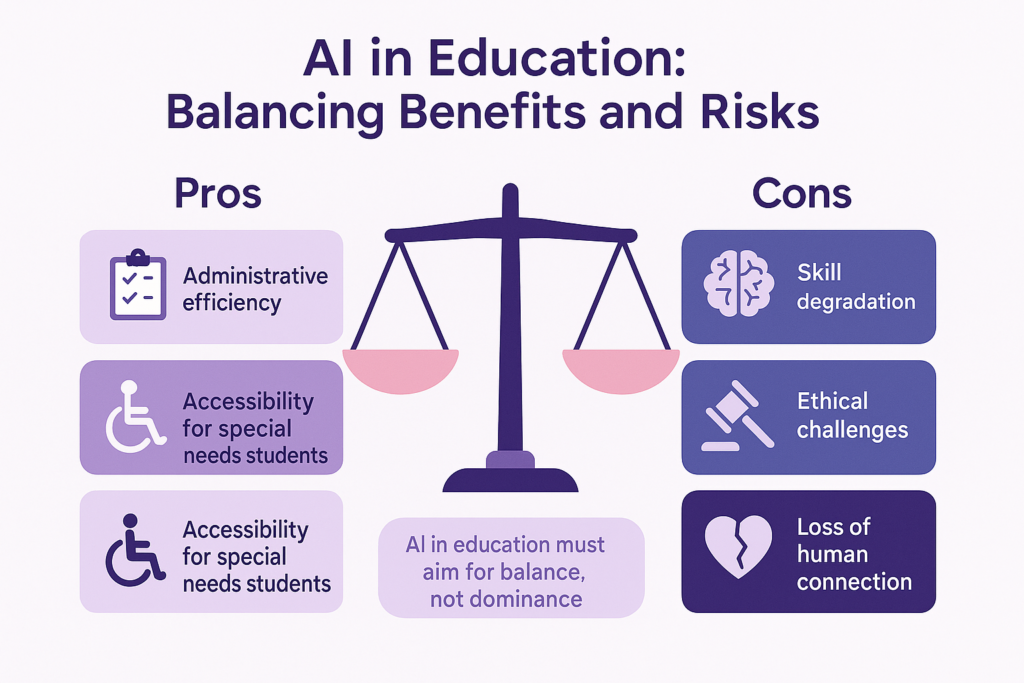
Is it time to hit the brakes on our headlong rush into AI in education? Let’s not discount the indubitable strides AI has made in redefining aspects of education. On the upside, administrative tasks have streamlined into seamless patterns; accessibility tools addressing individual learning needs have emerged; the untapped potential of personalized learning is starting to take shape.
But balance the coin, and a murkier picture forms on the other side. As we’ve been emphasizing, rampant AI adoption brings its own baggage – ethical quandaries surrounding data privacy, a widening digital divide, and the risk of skill atrophy. Above all, the essence of education – the human connection – stands undermined. Simplicity isn’t the ultimate virtue, especially when complexity is a close neighbour to richness and depth of experience.
Look, we can’t deny progress. But it’s clear we must approach this blending of AI in education with caution and mindfulness. The table below provides a simplified snapshot but remember – the story behind is much more intricate:
| Advantages of AI in Education | Setbacks of AI in Education |
| Increased administrative efficiency | Ethical concerns (e.g., data privacy) |
| Development of accessibility tools | Potential for skill degradation |
| Emergence of personalized learning | Erosion of human connection |
| Potential for customized learning paths | Risk of deepening the digital divide |
Isn’t it evident? Adopting AI for education isn’t a simple matter of swapping traditional methods for techy toys. We need to fiercely guard the essence of learning and instruction – the human connection, critique, creativity and collaboration, which are the bulwarks against an AI-induced sterile learning environment.
Final Thoughts: Education’s Core Amid AI Encroachment
Let’s recap. While the allure of AI in education may be great, we must tread mindfully. Surrendering blindly to its sleek efficiency poses risks of pedagogical damage, ethical pitfalls, and the sterilization of the learning process. Instead, educators and policymakers must peg their compass to true North – the fundamental goals of education.
Critical thought, harnessing creativity, fostering empathy, and sustaining human connection must take precedence over whiz-bang tech razzmatazz or mere speed. And so, we leave you with this call to action: advocate for, and actively work towards, incorporating AI in a manner that accentuates, rather than dilutes, the essence of education.