Artificial Intelligence is often depicted as the far-off future of education, a sleek and still somewhat speculative promise. The truth is more subtle, yet immensely more powerful.
AI has been slowly creeping into our classrooms and learning platforms, changing the way we teach and learn. Rather than just a buzzword, it’s a tool that already helps tailor education to individual learning styles, untangling the knots of traditional, one-size-fits-all education.
This article isn’t about hypotheticals or distant prospects. It aims to delve into the concrete ways AI is affecting education today, emphasizing both the inspiring benefits and the sobering challenges. Personalized, data-driven learning practices are no longer an exception; they are becoming a core feature of our education systems.
Let’s start this discussion by acknowledging that the so-called advanced future of education has already started, and it’s time to understand its impact in real terms.
Three Noteworthy Benefits of AI in Education
1. Paths Tailored to Personal Learning: The ability to cater to individual student needs sets AI apart in a powerful way. By gauging the difficulty level and pacing that each student can handle, AI essentially ‘personalizes’ content. The era of standard, one-fit-all educational models is fast becoming obsolete, making way for this fundamentally unique and game-changing attribute of AI.
2. Efficiency through Automation: Grading and feedback are integral to education, but the time and effort they need can be draining for educators. AI steps in to automate this process, alleviating teacher workload. Educators can then invest these saved hours back into what they do best – actual teaching.
3. Enhancing Accessibility: Fostering inclusivity, AI is a boon to diverse learners by deploying tools that harmonize accessibility issues. These digital aids mitigate learning barriers, broadening the educational opportunities available to differently-abled or disadvantaged students.
AI’s role in education is already making promising strides, proving its worth far beyond the hype. And while we’re aware of its challenges and limitations, recognizing AI’s potential should be equally important. As we delve into the exploration of AI’s impact on education, this balance will be pivotal.
The Interactive Dimension of Learning: AI at Play
The educational landscape is evolving, and it’s no longer just about pouring over static information. Today, AI provides a gateway to vibrant, immersive learning environments that pique a student’s curiosity. It invites them into interactive playgrounds, where knowledge is not passively absorbed but actively explored.
Take digital platforms like Edubrain, for example. They leverage AI to design intricate simulations that transport students to uncharted realms of learning. From the inner workings of a human cell to the vast expanses of space, education materializes before students’ eyes.
But AI’s reach extends beyond the visual; it concocts personalized experiences attuned to each learner’s preferences.
Imagine AI games for kids that adapt to a child’s learning style, progressively challenging them as they showcase mastery of concepts. Or consider the best AI science solver that simplifies complex problems and offers immediate, tailored feedback – a valuable tool nurturing understanding rather than mere rote learning.
By transforming passive recipients of knowledge into active participants, AI is reshaping education’s very anatomy. AI tools for kids are acting as catalysts, making learning an adventurous journey rather than a dictated script. This isn’t just about modernizing education; it’s about embracing fluidity and dynamism in how we learn, arousing an intrinsic enthusiasm for knowledge.
A Look at AI’s Impact: Advantages and Disadvantages in Education
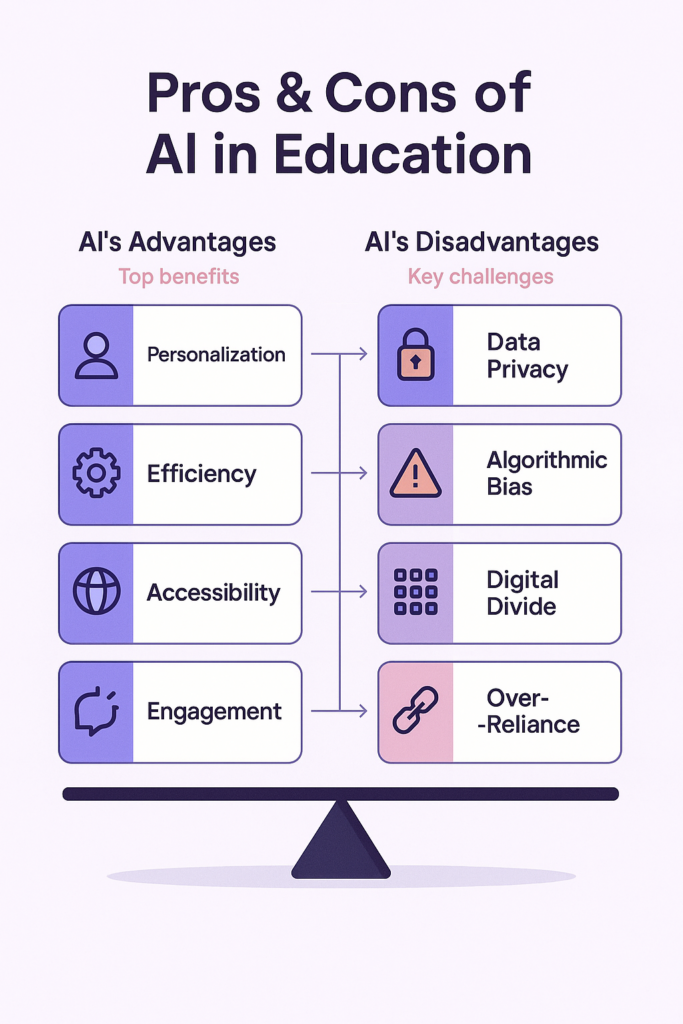
While AI undoubtedly presents appealing possibilities for education, let’s not forget the stability of the other side of the coin. On the one hand, AI’s ability to offer personalized learning paths and increased efficiency is undeniable. Also, it presents opportunities for enhancing accessibility. Conversely, serious challenges remain, including pressing issues of data privacy, the existence of algorithmic bias, and the widening digital divide.
| AI’s Advantages | AI’s Disadvantages |
| Personalization: A unique selling point of AI is its ability to tailor education to suit the unique learning needs of each student. | Data Privacy: Personalization involves extensive data collection, raising concerns about student privacy and data security. |
| Efficiency: By automating tasks such as grading, AI helps teachers carve out more time for instructing students. | Algorithmic Bias: AI’s decisions are not free from human bias, impacting the fairness of its output and potentially skewing learning outcomes. |
| Accessibility: Through specialized tools, AI can break down learning barriers, broadening the horizon for differently-abled students. | Digital Divide: Not all students have access to the digital tools required to benefit from AI. This can lead to widening educational gaps. |
| Engagement: AI has the potential to transform passive learning into an interactive experience, fostering greater student engagement. | Over-reliance: Handing too much power to AI invites the risk of diminishing human interaction in education, a crucial part of learning and development. |
AI presents us with a paradox – as it holds the promising power to redefine education, it also brings about challenges that need to be critically addressed for these advancements to be equitably leveraged. The question is, how can we harness the benefits while being cautious of its potential pitfalls? The key lies in thoughtful adoption, guided by robust policies, and ongoing evaluation.
Imagine engaging AI games for kids that adapt to a child’s learning style, progressively challenging them as they showcase mastery of concepts. Or consider using the best AI science solver to simplify complex problems and offer immediate, tailored feedback. This is a valuable tool nurturing understanding rather than mere rote learning. Such interactive methods, supported by excellent AI tools for parent to know, are transforming passive recipients of knowledge into active participants.
Guardian Steps for Student Data and AI Equity
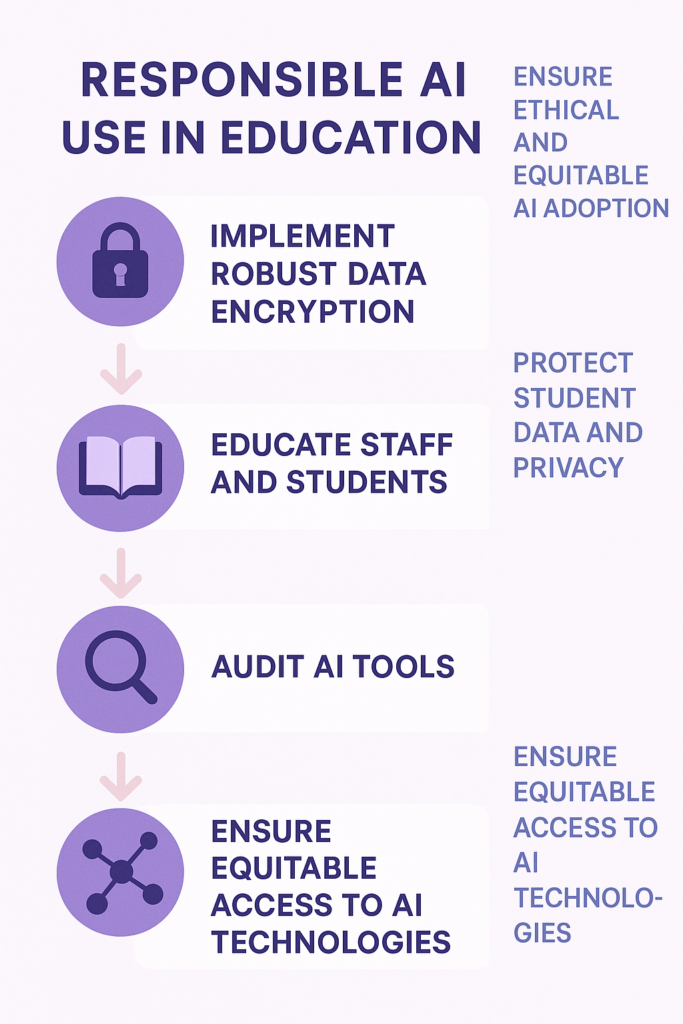
Without due vigilance, AI’s promise for education could turn into an ethical minefield. Therefore, to foster responsible AI implementation, a clear and precautionary roadmap becomes essential for educators, institutions, and parents alike.
- Building the foundation with robust data encryption and privacy policies is a step that cannot be undermined. Data governance becomes the cornerstone of maintaining privacy and preventing unethical misuse.
- Though AI is transforming education, its capabilities and limitations should be part of the curriculum. Both staff and students must be equipped with this knowledge to enable effective and informed use.
- Just as teachers assess their students, audit AI tools for algorithmic bias before they’re deployed in the classroom. Transparency in AI’s decision-making processes will preserve the sanctity of fair education.
- Lastly, for AI to be a true beacon of progress, it must reach all demographics equitably. Make access to AI technologies inclusive, not exclusive, eliminating the digital divide.
By taking these practical steps, the future of AI in education will align more closely with the promise it holds, rather than the risks it poses.
Teacher’s Role in the AI Era: Integral and Non-negotiable
Reflecting on the digital transformation in education, AI indeed contributes significantly. Personalized learning, greater efficiency, and enhanced accessibility have been realized. But there’s something AI still can’t quite grasp: the human touch. It’s an impersonal mechanism, detached from feelings, empathy, and intuition, qualities intimate to educators.
Teaching isn’t just about imparting knowledge; it’s about emotional availability, sparking curiosity, fostering creativity, and building critical thinking abilities. Consider the instances when a teacher discerns a student’s potential or detects their struggles through their behavior or facial expressions. That’s empathy in action. Similarly, challenges unforeseen by AI may appear in teaching. Experienced educators, however, navigate them effectively, molding each challenge into a learning opportunity.
In many ways, then, AI aids teaching rather than replacing it. It frees educators from mundane tasks, allowing them to dedicate more time to their students. The teacher remains center stage in a student’s learning journey, shaping the learners of tomorrow. AI merely complements, never substitutes, the irreplaceability of human educators. Through this lens, the AI revolution can be seen as a transition towards more efficient education, where teachers guide and AI assists.
Furthermore, an interactive approach means a child can use the best AI science solver not just for homework, but to explore scientific principles through various engaging mediums, including specialized AI games for kids on the road. This movement, driven by advanced AI tools for kids, is reshaping education’s very anatomy, making learning an adventurous journey rather than a dictated script.
Distilling Insights: Toward an Intelligent, Ethical Learning Environment
Artificial Intelligence holds immense potential for education but its implementation isn’t devoid of challenges. We’ve observed how AI can personalize learning, streamline tasks, and improve accessibility, as long as we keep students’ needs at the center. The pivotal role of teachers as nurturers and mentors, whose qualities AI cannot mimic, underlines the indispensability of the human factor in education.
Yet, adopting AI in education beckons careful navigation. Ethical considerations, such as data privacy, algorithmic bias, and equitable access, ought to be addressed proactively. Moreover, constant research, collective dialogue, and policy formulation should spearhead the efforts to shape AI’s role beneficially in education.
In refining this dual-edged tool, we tread toward a well-rounded educational ecosystem, where AI supports rather than supplants human teaching. The path, while still winding, invites exploration.
The Stakes are High: Shape AI’s Impact on Education
Having delved into the intricacies of AI in education, you can see the opportunities and challenges that unfold. The thought-provoking question is, what role do you want to have in this transformative journey?
Advocating for mindful integration of AI in education could be a conscious choice you make. This doesn’t mean blindly celebrating AI as a panacea, but rather understanding its potential, while staying vigilant about ethical considerations and the imperfections within the system.
As educators, students, parents, policy makers, stepping forward in shaping the narrative of AI responsibly can make a huge difference. Your voice matters: in classrooms, in debates, in policy formulations, even when evaluating an AI tool.
In crafting the future of learning, remember that AI takes its cue from ourselves. It can only reach its full potential when guided by thoughtful hands and an engaged community. After all, the essence of AI in education is not just about the technology, but about the people who use it and the value it brings to their lives.